Aflatoxin and Sudan Dye Terms for Dried Chili Inquiries
Many dried chili inquiries describe color, heat and pod size in detail and leave food safety to a single line: "must meet EU standard". That line is hard to quote against and harder to check at arrival. If your Beijing Red or Red Dragon 23 is going into sauces, seasonings or retail packs for Europe, name the tests, the limits and the lab basis in the inquiry itself.

Which contaminants matter for dried chili
Dried chili is dried in the open air or in dryers and stored for months, so the main risks are mold toxins, illegal dyes and pesticide residues. For the EU market, these are the items buyers most often put in a contract:
| Item | Where the limit comes from | EU figure for dried Capsicum | What to write in the inquiry |
|---|---|---|---|
| Aflatoxin B1 | Regulation (EU) 2023/915 | 5.0 µg/kg | "Aflatoxin B1 ≤ 5 µg/kg" |
| Total aflatoxins (B1+B2+G1+G2) | Regulation (EU) 2023/915 | 10.0 µg/kg | "Total aflatoxins ≤ 10 µg/kg" |
| Ochratoxin A | Regulation (EU) 2023/915 | 20 µg/kg | "Ochratoxin A ≤ 20 µg/kg" |
| Sudan I–IV and similar dyes | Not authorized as food colors in the EU | Not detected | "Sudan I–IV not detected, state LOD" |
| Pesticide residues | Regulation (EC) No 396/2005 (MRLs) | Per substance | "Meets EU MRLs, multi-residue screen" |
| Ethylene oxide | EU MRL framework | At limit of quantification | Ask that the lot is not treated with ethylene oxide |
These figures apply to Capsicum whether whole or ground, so the same numbers cover whole Beijing Red pods and crushed or powdered Red Dragon 23. Check the current consolidated text before you sign: EU limits are amended from time to time, and the UK, the US, the Middle East and Southeast Asia each have their own rules.
Write the limit and the method together
A limit without a method leaves room for argument. For mycotoxins, ask for HPLC or LC-MS/MS results and the lab's limit of detection. For Sudan dyes, a "negative" result means little unless the report states the detection limit. For pesticides, a multi-residue screen is more useful than a list of three or four substances.
Also decide who tests:
Supplier's pre-shipment test on the production lot, reported on the COA.
Third-party lab chosen by the buyer, with sampling witnessed or done by an inspection company.
Buyer's arrival test, with the retained sample as the reference if results differ.
Many buyers combine the first and third. If you need a named lab, put the name in the inquiry so the cost is included in the quotation.
Link the report to the shipped lot
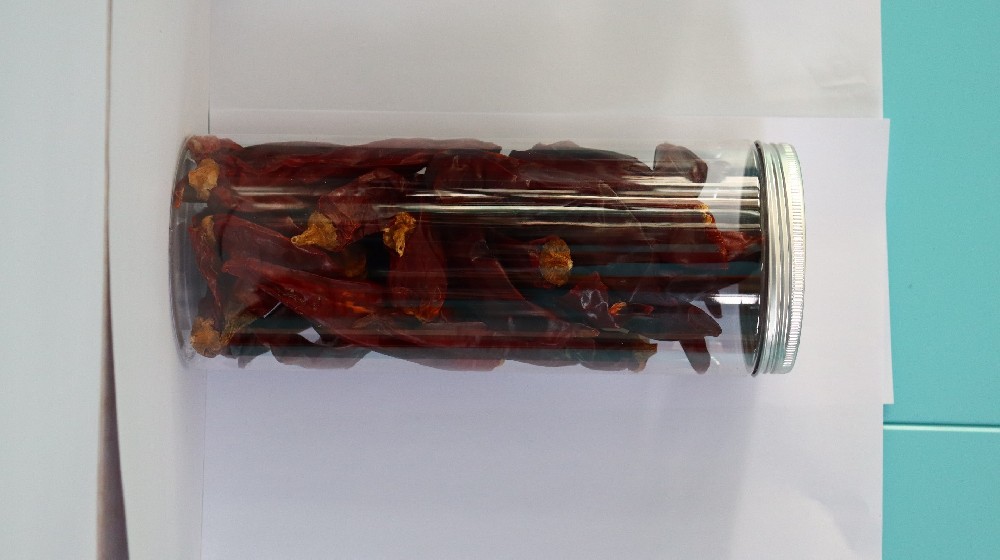
A clean lab report only helps if it belongs to the goods in the container. Ask for the lot or batch number to appear on the lab report, the COA (see what to check on a Red Dragon 23 COA), the bag labels and the packing list. Ask the supplier to keep a sealed retained sample from the same lot, like the jar in the photo above. If an arrival test fails, both sides then test the same material instead of debating which sample was sent.
How variety affects the conversation
Beijing Red is usually bought for color, for chili oil, hot pot base and seasoning powder, and often goes on to grinding. Red Dragon 23 is more often sold as whole pods where appearance counts, so stem and foreign matter terms also matter (see how to specify stems and foreign matter). The food safety limits are the same for both. What changes is the processing route: crushed and powdered chili passes through more handling, so buyers of ground product often add microbiology (total plate count, yeast and mold, Salmonella) to the specification.
FAQ
Is "complies with EU standard" enough in a purchase contract?It is better than nothing, but it does not say which tests were run or at what detection limit. List each item, its limit and the test method, as in the table above.
Do whole pods and chili powder need different mycotoxin limits for the EU?No. Regulation (EU) 2023/915 lists dried Capsicum "whole or ground" under the same aflatoxin and ochratoxin A limits. Powder buyers often add microbiological limits because of the extra processing.
About ChangFengAgro
ChangFengAgro is a chili and spice supplier in Jiaozhou, Shandong, China. We supply Beijing Red and Red Dragon 23 dried chili, paprika, dehydrated garlic and ginger and other spices to food manufacturers, importers and private-label buyers. Send us your target market and specification table and we will tell you which tests and documents can be provided for your lot. Email [email protected] or WhatsApp +86-13355329772.