Dried Chili Arrival Checks: Sample, COA and Lot Match
When a shipment of Beijing Red or Red Dragon 23 dried chili arrives, the first task is to confirm that the bags in front of you are the same lot you approved. Match the lot number on the bag marks with the certificate of analysis (COA) and with the retained sample, then draw a receiving sample and compare it with that reference before the goods go into production.

What should you check before the bags are opened?
Start with the documents and the marks on the bags, not with a handful of pods from the nearest pallet. Confirm the variety name — Beijing Red (北京红) or Red Dragon 23 (红龙23) — the product form (whole stem-on, whole stemless, crushed, flakes or powder), the lot number, the net weight and the number of bags against the packing list and the invoice. The note on bag marks, liners and labels lists the fields that should already be on the bags; if a bag has no lot number, or the number does not match the COA, set that pallet aside before anyone cuts a stitch.
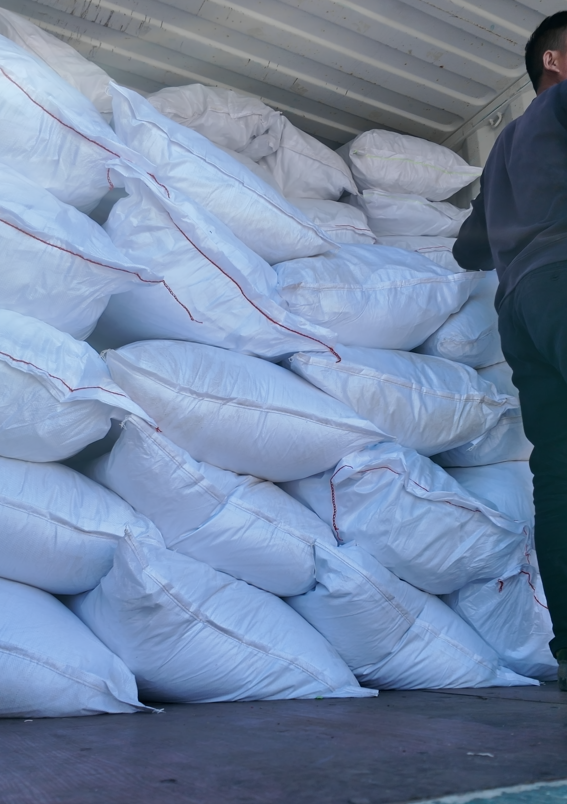
Also look at the condition of the load. Wet or stained bags, a torn liner, a musty smell or obvious mixing of forms are reasons to photograph the container or truck and to record bag numbers before the lot is put away. This is a receiving check, not a claim decision by itself, but it is much harder to reconstruct once the bags have been restacked in the warehouse.
How should a receiving sample be drawn?
A sample taken only from the first bag on the first pallet rarely represents a container. Draw from several bags, in different positions in the load, and keep the draws labelled so you can say which bag they came from. Use the form you actually ordered: a whole-pod draw does not stand in for crushed chili or powder of the same variety, a point also made in the sample approval note for Beijing Red and Red Dragon 23.
Take enough material for a visual comparison, the laboratory tests in your specification, a short line trial if you need one, and a sealed retain sample. Label the retain with the variety, form, lot number, arrival date and the bill of lading or container reference. There is no single official draw weight that fits every buyer; the useful rule is that the arrival sample and the approved reference should be comparable in form and in quantity, not that one scoop from one bag is enough.
What should the receiving sample be compared with?
Compare the arrival draw with two things at once: the written specification, and the retained portion of the sample you already approved. The table below is a receiving checklist, not a published specification for either variety. Changfeng Agro’s public Red Dragon 23 profile gives typical colour of 160–220+ ASTA and typical pungency below 5,000 SHU as positioning figures, not a guarantee for every lot. Beijing Red should be checked against the numeric limits you agreed for that variety, not copied from the Red Dragon 23 profile.
| Check | Why it matters on arrival | What to record |
|---|---|---|
| Lot, variety and form | A correct COA for the wrong bags, or a mixed form in one lot number, cannot be tied back to the approved sample | Lot number on bags, COA and retain sample; variety name; product form |
| Appearance against the approved sample | Colour, broken pods, stems and loose seed can drift from the reference even when the lot name is the same | Visual match or difference; defect and foreign-matter counts against the limits in visual defect grading and stems and foreign matter |
| Moisture | Moisture can move during a sea voyage if a liner fails or bags sit against a wet wall; the shipped COA may no longer describe the goods as received | Arrival moisture % and method, compared with the contract maximum and the shipped result; see moisture and storage requirements |
| Colour and heat, if contracted | ASTA and SHU are lot results, not variety names; a receiving test is the only way to see whether the arrival lot still sits inside the agreed range | Arrival ASTA (for example ASTA 20.1) and SHU or capsaicinoid result, against the specification and the COA; variety context is in Beijing Red and Red Dragon 23: colour, heat and product form |
| Particle size and seed content | For crushed chili, flakes and powder, a visual check of whole pods will miss a change in cut size or seed ratio | Mesh or mm range and seed % by weight, as written in particle size and seed content |
| Food-safety documents | Destination tests belong with the same lot number as the bags, not with a generic certificate for the variety | Whether aflatoxin, Sudan dye, pesticide or microbiology results, if required, identify this lot; see aflatoxin and Sudan dye terms and crushed chili microbiology specs |
If you will use the chili in oil, sauce or a dry blend, run a small trial on the arrival form, not only on the laboratory sheet. A lot can meet the numbers and still behave differently on the line if the cut, the seed content or the odour has changed.
What if the COA and the arrival sample do not agree?
Hold the lot out of production until the difference is explained. First check whether the laboratory used the same method and the same product form as the COA and the contract. A powder result is not a direct check of a whole-pod shipment, and two laboratories can disagree if the sample was taken from different bags. The Red Dragon 23 COA checklist is the place to confirm that the certificate actually refers to this lot number.
Write down the bag numbers you sampled, keep the retain sealed, and compare it side by side with the approved reference. A receiving discrepancy is a question about this lot, not a reason to rewrite the specification or to accept a substitute grade without a new approval.
How long should the arrival retain sample be kept?
Keep it at least until that lot has been used, and long enough after the last bag to investigate a complaint from your own customer. Store it under the same dry, sealed conditions you require for the bulk chili, and label it so it cannot be mixed with a later lot or with the original pre-shipment retain. Those two retains answer different questions: one shows what you approved before shipment; the other shows what was in the bags when they arrived.
FAQ
Can the shipment be accepted on the COA alone, without opening bags?
The COA does not show wet bags, a mixed lot, a missing liner or a visual drift from the approved sample. Use the certificate to check the lot identity and the contracted results, then confirm those points on a receiving draw.
If arrival moisture is higher than the shipped COA, should the lot be rejected automatically?
Not automatically. Check bag and liner condition, compare the arrival result with the contract maximum, and decide against the written limit, not against the shipped number alone. If the contract maximum is exceeded, hold the lot and raise it with the supplier, with the bag numbers and the retain sample attached.
About ChangFengAgro
ChangFengAgro is a chili and spice supplier in Jiaozhou, Shandong, China, supplying Beijing Red and Red Dragon 23 dried chili, crushed chili, chili powder, paprika and other spices to food manufacturers, importers and private-label buyers. When you send an arrival question, include the lot number, the bag marks, the COA and a note on what the receiving sample shows against the approved reference. Email [email protected] or WhatsApp +86-13355329772.